A shoe is more of an engineered product than it looks: a last that determines size and comfort; an upper made of leather, fabric or a synthetic material; a sole whose material determines lifespan, weight and slip resistance; and a way of joining the two that separates a shoe that lasts for years from one whose sole comes away after a month. With military boots and safety footwear, all of this turns into specifications that can be tested against international standards, because here the shoe is protective equipment, not a fashion item.
This page covers everyday and sports shoes, military and tactical boots, and occupational safety footwear. Clothing — including high-visibility workwear — has its own Clothing page, and belts and backpacks are covered under Accessories.
Where are shoes made in China?
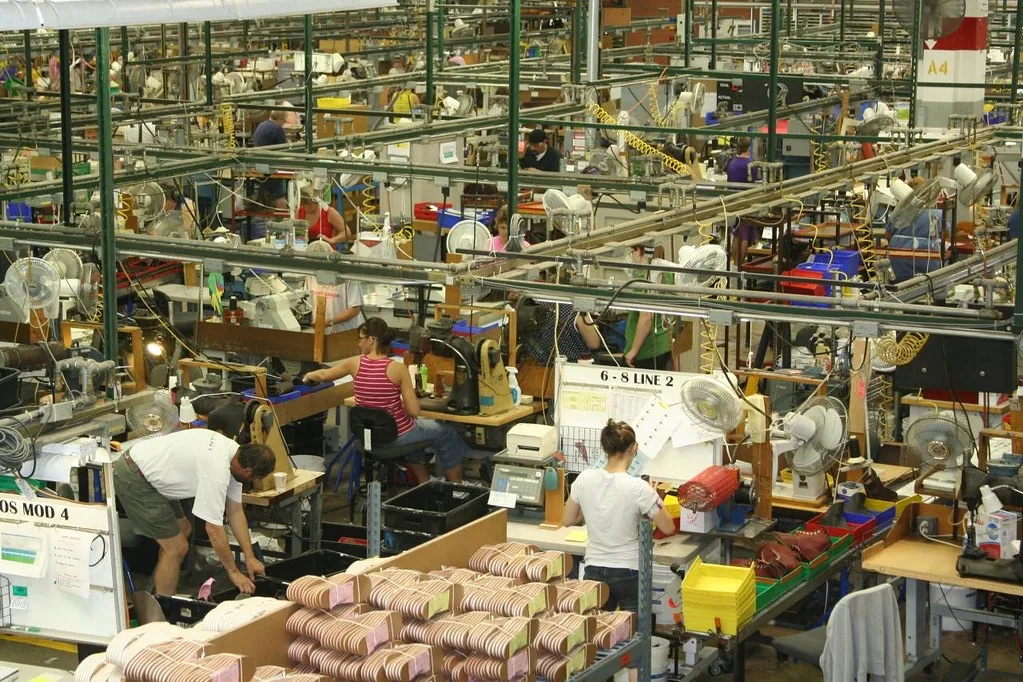
Shoe manufacturing is concentrated in Fujian, Guangdong and Zhejiang, with clear specialisations: Fujian for sports shoes, Guangdong for export production and women's shoes, and Zhejiang for men's leather shoes and injection-moulded shoes.
- Fujian: Jinjiang, in Quanzhou, is China's sports shoe capital and home to major Chinese sportswear brands, while Putian is a large centre for manufacturing sports shoes on behalf of other brands.
- Guangdong: Dongguan — and its town of Houjie in particular — is a centre for export shoe manufacturing and for footwear materials and machinery; Guangzhou has wholesale shoe markets and women's shoe factories; and Huidong, in Huizhou, makes women's shoes and budget sandals.
- Zhejiang: Wenzhou for men's leather shoes, and Wenling, in Taizhou, for injection-moulded shoes, lightweight shoes and slippers.
- Sichuan: Chengdu is a well-known centre for women's shoes.
Military and tactical boots and safety footwear are made in fewer, more specialised factories spread across Fujian, Guangdong, Shandong and elsewhere. The criterion for choosing one is not the region but the factory's testing capability: does it have an in-house laboratory for bond strength and flexing, and does it hold reports from independent laboratories against the standard you require?
What materials and construction methods are used in shoes?
A shoe is defined by three elements, and no quotation is complete without them: the upper material, the sole material, and how the two are joined. Swapping any of them for a cheaper material changes both the price and the lifespan, so each element is specified by name, not by description:
| Element | Common options | What goes into the specification |
|---|---|---|
| Upper | Full-grain or split natural leather, microfibre, PU, woven mesh, canvas, high-density nylon | Leather type, layer and thickness in millimetres, or fabric density such as 1000D |
| Midsole | EVA, Phylon (compressed EVA), PU | Density, hardness and weight per pair |
| Outsole | Natural or synthetic rubber, nitrile rubber, TPR, PU, PVC | Material, abrasion resistance, and oil and slip resistance where needed |
| Construction method | Cemented, vulcanised, direct injection, Goodyear welt | The method by name, with a minimum sole bond strength |
| Protective toecap | Steel, composite (fibreglass, carbon or engineering plastic), aluminium | The material and the protection level in joules under the required standard |
Each construction method has its own logic. Cementing is the most common and cheapest method for sports and women's shoes, and its quality depends on the adhesive and on surface preparation. Vulcanisation is used for canvas shoes with rubber soles. In direct injection, the sole is moulded onto the upper inside the mould, so the two fuse without adhesive; it is common in safety and work footwear. Goodyear welt construction attaches the sole via a stitched strip, which makes the shoe heavier and more expensive but more durable, and allows it to be resoled; that is why it is preferred for heavy-duty military boots.
What are the specifications of military and tactical boots?
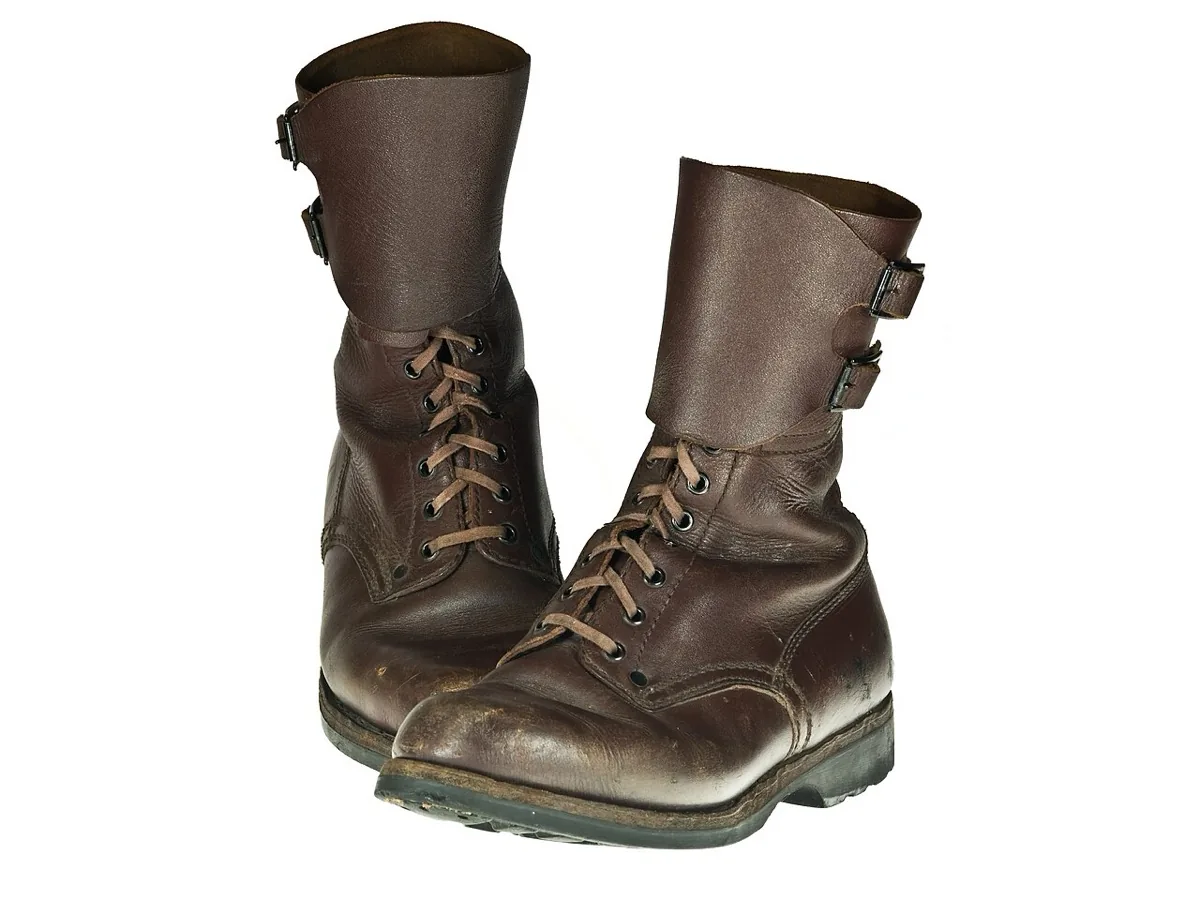
A military boot is defined by how it stands up to conditions, not by how it looks: a full-grain leather upper with high-density nylon panels, a rubber sole resistant to slipping, oil and heat, a shaft that supports the ankle, water resistance proven by testing, and a protective toecap at a specified level if required. The specifications that go into the contract:
- Upper: full-grain leather of a specified thickness — often between 1.8 and 2.2 mm in military boots — with nylon panels of a density such as 1000D in lighter models, and leather pre-treated against water.
- Sole: rubber resistant to oil and fuel, with a deep tread pattern that sheds mud, and resistant to contact heat if the boots will be used in the desert or near hot equipment.
- Water resistance: treated leather with a gusseted tongue joined to the sides to keep out water and sand, or a waterproof inner membrane that lets vapour escape. This is proven by testing, not by description: water penetration through the upper under flexing, or immersion of the whole boot.
- Toecap: steel or composite in heavy tactical boots and safety footwear, or no protective toecap in lightweight combat boots that put weight and flexibility first.
- Hardware: rust-resistant eyelets and hooks, a side zip from a well-known brand if required, and high-strength nylon thread.
- Colour: black, sand or “coyote”, in a shade approved against a sample, because shade differences between batches are usually rejected in orders for official bodies.
When the purchasing body requires a military specification such as MIL-SPEC, or its own national specification, the reference is the specification number and edition stated in the tender documents, not the factory's catalogue. Ask for test reports that cite the specification itself by number, check that they come from an independent laboratory, and do not accept the phrase “meets military specifications” without a number.
What is the EN ISO 20345 standard for safety footwear, and what are its categories?
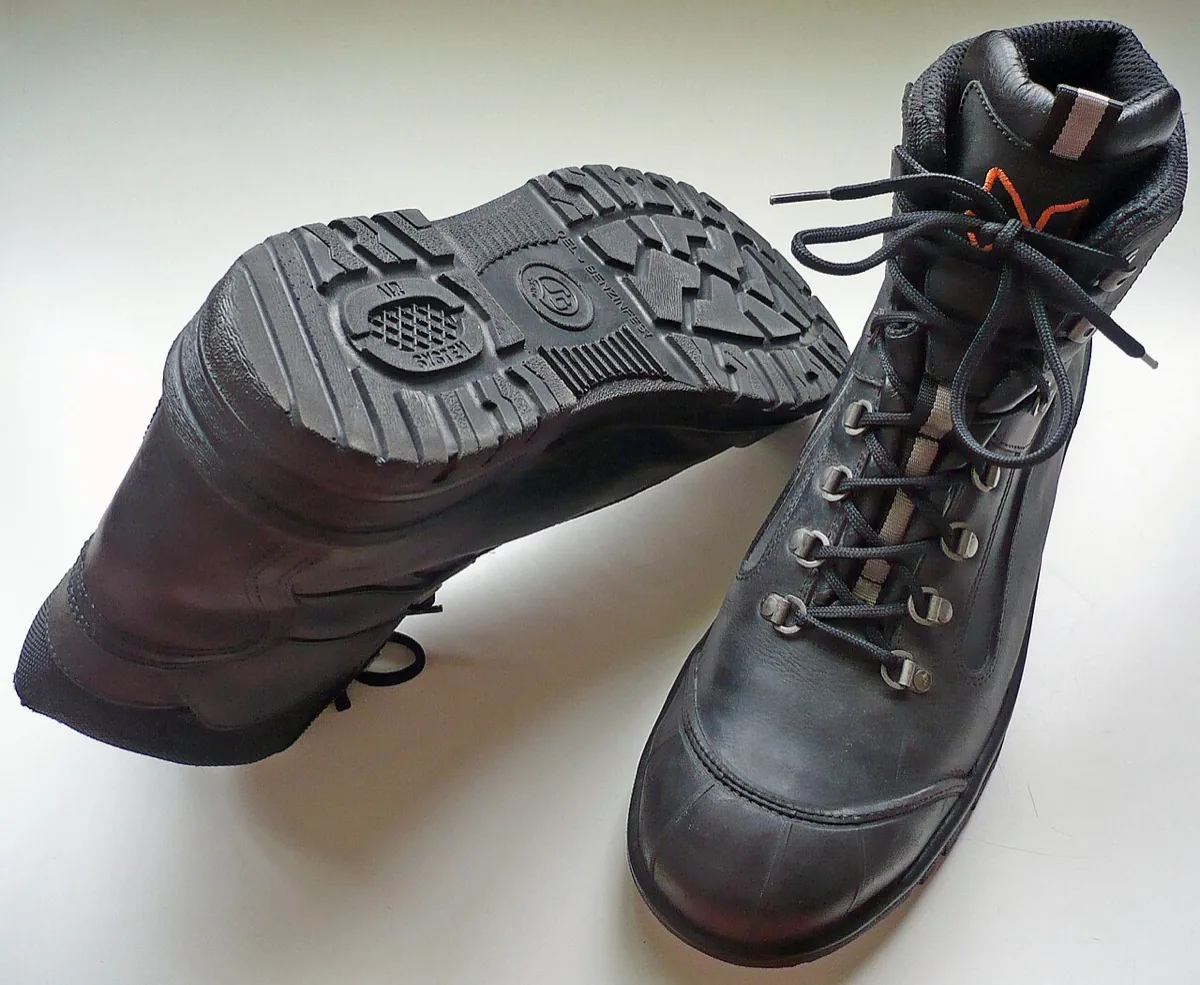
EN ISO 20345 is the international standard for safety footwear: it requires a protective toecap that withstands an impact of 200 joules and a compression load of 15 kilonewtons, and it then classifies footwear into categories that show the additional protection provided. It has two companion standards: EN ISO 20346 for protective footwear with a 100-joule toecap, and EN ISO 20347 for occupational footwear without a protective toecap. In the United States, ASTM F2413 covers footwear with protective toecaps. These are the main categories:
| Category | What it adds | Typical use |
|---|---|---|
| SB | The basic requirements, including the protective toecap | Dry environments where the only hazard is falling objects |
| S1 | A closed heel area, antistatic properties and energy absorption in the heel | Dry warehouses and factories |
| S2 | Everything in S1, plus resistance of the upper to water penetration and absorption | Environments with splashing or wet cleaning |
| S3 | Everything in S2, plus sole penetration resistance and a cleated outsole | Construction sites and projects |
| S6 | Everything in S2, plus water resistance of the whole shoe (2022 edition) | Long periods of work in wet environments |
| S7 | Everything in S3, plus water resistance of the whole shoe (2022 edition) | Exposed sites in rainy conditions |
Codes for additional protection are added to the category according to the working environment. The most common are: P for sole penetration resistance with a metal insert (in the 2022 edition, non-metallic inserts are coded PL or PS depending on the diameter of the nail used in the test); HRO for a sole that withstands contact with a surface at 300 °C; CI and HI for insulation against cold and heat; WR for water resistance of the whole shoe; M for metatarsal protection; and FO for sole resistance to fuel and oil.
Slip resistance deserves a closer look. In the 2011 edition it was coded SRA, SRB and SRC; in the 2022 edition, a slip test on ceramic tile with a detergent solution became a basic requirement, and the code SR was added for an additional test on a surface contaminated with glycerine. So if a factory quotes you a code, ask: under which edition of the standard? And ask for the report that proves it. Editions are updated, so check which edition is recognised in the destination country before production.
What should be checked before supplying footwear to military or security bodies?
Supplying footwear and equipment to military or security bodies may be subject to special requirements and licences in the destination country, and checking them must come before contracting with the factory, not after. Some countries require supplier prequalification or a special import licence for equipment destined for these bodies; some restrict imports of items that match official uniforms or carry the emblems and insignia of the armed forces; and the purchasing body may require inspection or approval of the sample before shipment.
- Check the requirements with the competent authority in your country or with a legal adviser before signing — Alshumul does not provide legal advice.
- Do not print an official body's emblem or insignia on the goods without its written authorisation.
- Keep civilian tactical boots, sold to individuals, private security companies and hikers, separate from supplying an official body under tender documents, because each follows a different route.
How do you align shoe sizes across different sizing systems?
Use foot length in millimetres as your single reference, not European or US size numbers alone, because conversions between them are not standardised across factories. The Chinese system expresses foot length in millimetres — size 250 means a foot 25 centimetres long — while the European system uses a unit equal to two-thirds of a centimetre, the US and UK systems use different units again, and conversion tables can differ by half a size or more from one factory to another.
- Ask for a table that links each size to foot length and to the shoe's internal length in millimetres.
- Specify the width, because a narrow last does not suit many consumers, and it causes as many returns as length does.
- Approve the last against a sample, because the last is what actually determines size and comfort, and changing it between sample and production changes everything.
- Set the size curve according to your market; men's sizes usually run from EU 39 to 45, with the quantities concentrated in the middle.
Which inspections and tests matter for shoes?
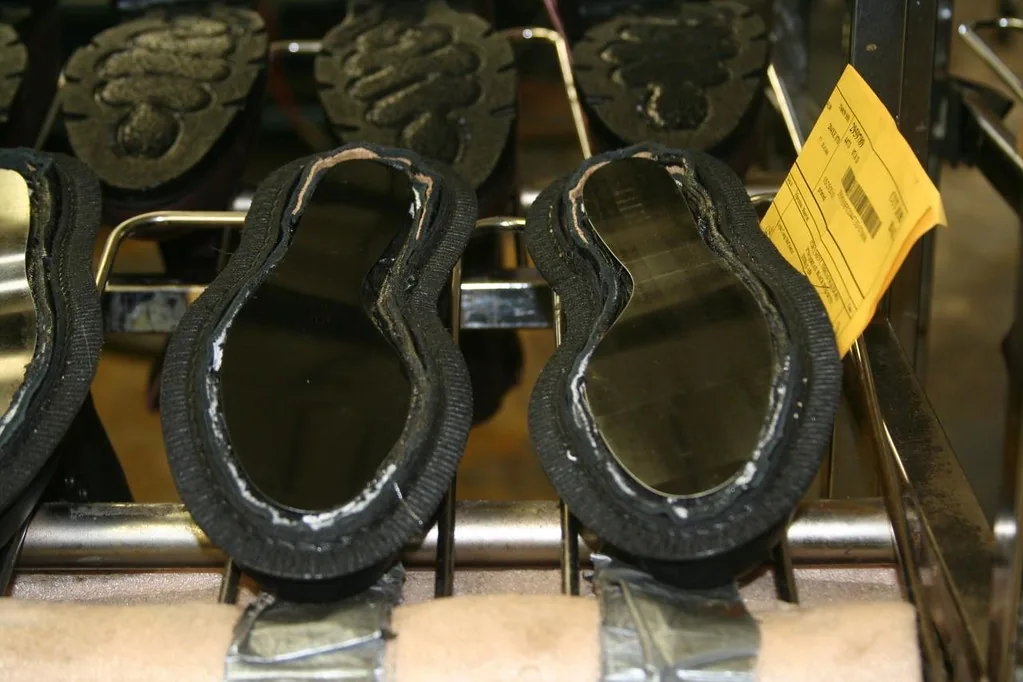
The most important test for any shoe is the bond strength between the sole and the upper, because sole separation is the most common defect in shoes and the most damaging to a seller's reputation. Alongside it:
- Flex resistance: flexing the sole and the upper thousands of times to see whether cracks appear.
- Abrasion resistance: how much material the outsole loses under friction.
- Restricted substances: hexavalent chromium in chrome-tanned leather, which the European Union limits to 3 milligrams per kilogram in leather articles that come into contact with the skin; azo dyes; and DMFu, an anti-mould agent banned in Europe after it caused skin allergies in people using shoes and furniture treated with it.
- Production inspection: the two shoes in each pair matching in size and colour, straight stitching, visible adhesive residue, cleanliness of the shoe, and the condition of the box.
Because shoes are inspected by pair and by size, make sure the pre-shipment inspection plan covers samples from every size and colour at a clear acceptance level, as explained in Pre-shipment inspection and AQL standards, and read the result as set out in the guide How to read an inspection report.
What are the common risks in importing shoes?
The biggest risks with shoes are counterfeiting, mould, differences in material and last between the sample and production, and claimed standards with no reports behind them.
- Counterfeiting: sports shoes are among the most counterfeited goods in the world, and a sole design or side stripes can be protected just like a logo; a counterfeit shipment is liable to seizure and destruction. See Protecting your brand and intellectual property.
- Mould in the container: leather, soles and adhesive trap moisture, and a sea voyage through hot regions is enough for mould to appear. Prevention means thorough drying before packing, permitted desiccants, and anti-mould papers free of banned substances.
- Material substitution: full-grain leather in the sample and coated split leather in production, or a rubber sole in the sample and TPR in production. The remedy is an approved sample cut open to show the cross-section, and materials named in the contract.
- A changed last: production shoes that are slightly narrower or shorter than the sample. The remedy is measuring the internal lengths during inspection.
- Claims without reports: “steel toecap”, “slip-resistant” or “S3” printed on the box without a laboratory report — this alone is reason enough for a shipment to be rejected in a market that requires certification.
How are shoes shipped from China?
Boxed shoes reach the volume limit before the weight limit, so they are priced by the cubic metre, and the most suitable container for large quantities is a 40-foot high cube. The size of the shoebox drives the calculation: a 40-foot high-cube container holds a few thousand pairs of boxed sports shoes, and far fewer high-shaft military boots, because their boxes are larger. The actual figure depends on the carton dimensions, so calculate it from the packing list, not from a general estimate.
- Double-wall export cartons holding a fixed number of pairs, with the size breakdown written on the outside of each carton.
- Inner stuffing to keep the shape of the toe, desiccants, and a bag for each pair.
- For small quantities, groupage with stronger packing, because the parcels are handled more — see LCL groupage shipping, and for the point at which to switch to a full container, the FCL vs LCL guide.
The HS code falls within Chapter 64 of the Harmonized System and is determined by the material of the upper and the sole, with separate subheadings for footwear with a protective metal toecap. So write a description of the actual materials on the invoice, because the word “shoes” alone is not enough for correct classification.
How do you import shoes from China?
- Define the use first: everyday, sports, safety or military — the use determines the standard and the materials before the design.
- Write the specification: upper material and thickness, sole material, construction method, protective toecap, the standard's category and codes where applicable, and the size table in millimetres.
- When supplying military or security bodies, check the destination country's requirements and licences before making any commitment to the factory.
- Find a factory that specialises in the same category and ask for its previous test reports; a factory audit before ordering is advisable.
- Request samples in the main sizes and test them by wearing and measuring, together with a cut-open sample that shows the material and sole construction.
- Approve the sample and the last, and sign the purchase order with the specifications and the required test reports.
- Monitor production at the cutting and sole attachment stages, and ask for bond tests on pairs from the actual production run.
- Inspect before shipment with samples from every size and colour.
- Arrange shipping and review the documents, HS codes and test reports before sailing; for conformity certification routes, see Product certifications: SASO/SABER, ECAS and CE.
Alshumul's role in importing shoes and military boots
Alshumul Commercial Services is an import and export company based in Guangzhou, close to Guangdong's shoe manufacturing hubs, and we work with factories in Fujian and Zhejiang when the specialisation you need is there. What we handle:
- Sourcing and verifying specialist factories: a sports shoe factory is not a safety footwear factory, and we tell the factory that owns the injection or stitching line apart from the middleman who passes the order on.
- Factory audits and visits: production lines, the in-house laboratory, and previous test reports against the required standard, together with where they came from.
- Requesting and following up samples, and comparing them with the written specification before approval.
- Negotiating directly with the factory in Chinese on materials, the last, the standard's category and codes, and price.
- Production monitoring and pre-shipment inspection: bonding, stitching, sizes and packing, with an illustrated report before loading.
- Arranging shipping by full container load or groupage through shipping lines and consolidators, reviewing documents before sailing, and following up until the port of discharge.
For orders from military and security bodies in particular: checking the licences and supply requirements in the destination country is the importer's responsibility, working with the competent authority or their legal adviser, and our role begins on the factory side once the regulatory route is clear. Customs clearance in the destination country is outside the scope of our service.